Wednesday, 6 January 2010

Virtual Tourism


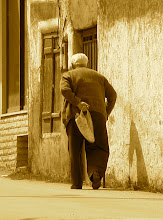
It is what it is, as they say...I just found this mildly amusing. Sitting in a cafe watching the world go by on holiday in Istanbul, I saw the above couple, also on holiday. She is checking the recently-taken photographs of Istanbul on her camera, he is reading the 'Time Out' guide to Istanbul. It reminded me of Baudrillard, and here is the precise quotation that this image brought to my mind:

"Today, when the real and the imaginary are confused in the same operational totality, the aesthetic fascination is everywhere. It is a subliminal perception..of deception, montage, scenaria..Reality no longer has the time to take on the appearance of reality..The principle of simulation wins out over the reality principle.." (Simulations).

In a cafe, In Istanbul..looking at pictures of Istanbul, reading a book about Istanbul.

It reminds me also of a snatch of dialogue from the film 'Total Recall':

"Come to Rekall lncorporated...where you can buy the memory of your ideal vacation...cheaper, safer and better than the real thing."

Some, it seems, prefer the Rekall solution - they don't want to be on holiday, they just want to HAVE been on holiday.

Monday, 21 December 2009

Neuromancer Cyber-Life, Christmas 2009


("My God, what a terrible programme"; "Sorry, force of habit.")

I remember years ago reading a series of novels by William Gibson and, even more recently, a series of novels by Richard Morgan. Both were set in bleak, post-apocalyptic dystopias featuring a cast of characters with extra-genetic modifications to their bodies enabling them to download tetrabytes of whatever directly into their brains (and so on and so forth...). They were the literary (superior) equivalents of 'Bladerunner', 'Matrix' and 'The Thirteenth Floor.' Well, it would be ridiculous to say that I'm still waiting...I live in Lebanon, where government-backed monopolies and corrupt network administration mean that I can't even get a decent internet connection most of the time. The two (two!) mobile phone network providers have got the market sewn up, iPhones (if you can get them unlocked) can never be upgraded because they will freeze and so are little more than fashion accessories and, in terms of the internet, there is a plethora of pay-as-you-go options at $50 dollars a time (for 2GB at best), a handful of wi-fi hotspots around the capital (Beirut) but, with the regular electricity interruptions, maintaining a connection is fraught with difficulty.

I woke up this morning and the electricity was off (6.00-9.00, 9.00-12.00, 12.00-15.00, 15.00-18.00 are the cycles, and my building has no generator: I don't mind because at least that means one less machine pumping out unfiltered petrol fumes into the environment), so I had to content myself with reading a book until it came back on when I could check (in no particular order)

* The Guardian;
* this blog;
* my flickr page;
* my hotmail, gmail and work e-mail accounts;
* my Twitter page (together with Ninjalabz);
* Facebook;
* a collection of local newspapers, citizen journalist pages (Demotix, Now Public) and a few blogs.

which took time. The loudest noise in The Guardian (bye bye Copenhagen...) was being made about the success of a Facebook/Twitter campaign to get a particular song by a certain band into the 'Christmas Number 1' slot in the UK charts, solely in order to defeat another song/artist on the sole grounds that the latter was a 'manufactured' event created as a result of participating in some TV game show or other ('X Factor' or 'Britain's Got Talent' or whatever).

http://www.guardian.co.uk/music/2009/dec/20/rage-against-machine-christmas-number-1

Following it were several opinion pieces, an endless list of opinions on the subect, fact and counter-fact (Rage Against The Machine are also operating under Sony BMG so the villain of the piece, one Simon Cowell, will still make piles of cash/No he won't, he's a non-executive director, and anyway RATM will donate the proceeds to a homelessness charity....and so on). I then switched on the radio (BBC Radio Five Live), and it was the subject of conversation there also.

Meanwhile here in Lebanon, a Syrian bus carrying workers going back to Syria was this morning shot up and one passenger was killed, whilst a Cloud search on Ninjalabz revealed that the biggest story of the day was about the death of some actress or other.

Inbetween times, I had always wondered why Twitter was not so popular in Lebanon as Facebook (with some honourable exceptions). It is, of course, to do with what people use it for; I have noticed that, in Greece, Twitter is a great way of organising demos, providing information about the location of riot police and so on during said demos, publishing real-time photos and links; Facebook, on the other hand, and to quote the satirist Jeremy Hardy, "is the modern equivalent of sorting out your sock draw" - it tells me who is, and is not, happy about the snow, the weather in general, their impending new baby, whether they had a good time last night, where they will be meeting up for a night out, and how many presents they have received on 'Farmville' or who they are playing online poker with. Most of all, probably, Twitter just doesn't allow people to post photographs of themselves at last night's party or to go on and on about how happy or not they are. After all, 160 characters just doesn't cut it, does it?

I suspect that, if Gibson and Morgan were to write their novels now, they wouldn't be full of surreptitious references to Baudrillard and Sadie Plant and Slavoj Zizek; instead, we'd all be wearing dark glasses with the Facebook 'live feed' being projected behind our retinas, and the National Inquirer entertainment section being fed into our cerebral cortex.

Wednesday, 12 August 2009

Cuba, 1984. ¿El trabajo enaltece al hombre? (A visit to Cuba, Part 1)


"At one end of [the hallway] a coloured poster, too large for indoor display, had been tacked to the wall. It depicted simply an enormous face, more than a metre wide: the face of a man of about forty-five, with a heavy black moustache and ruggedly handsome features…On each landing, opposite the lift-shaft, the poster with the enormous face gazed from the wall. It was one of those pictures which are so contrived that the eyes follow you about when you move. BIG BROTHER IS WATCHING YOU, the caption beneath it ran…He sat down and began to write in his diary...He did not know what had made him pour out this stream of rubbish. But the curious thing was that while he was doing so a totally different memory had clarified itself in his mind, to the point where he almost felt equal to writing it down." (George Orwell, ‘1984’, Chapter 1)


It's perhaps a bit hoary, I don't know, to return from a few weeks in Cuba and compare it to George Orwell's '1984'. I suspect the comparison has been made before; I don't know if it has, and nor do I care. It was a comparison that assailed me almost as soon as I arrived. On one of my final days there, I was at the ticket office of the bus station in Holguín with a travelling companion and, apropos of whatever we were discussing at the time (I can't remember, and it doesn't matter), he said to me, "When you know what's happening in Cuba, you can't possibly enjoy it."

The frontispiece in the 'Lonely Planet' guide had instructed me to leave my prejudices at home and open my mind (or something to that effect). My prejudices were/are all quite leftist anyway (an understatement...), but I was quite happy to do as suggested; however, as some satirist or other once wrote, "if you open your mind too much your brain might fall out."

I speak Spanish. Fluently. This is not a boast, just a matter of fact. At times during the weeks there I wished that I had not had this ability. I toyed with the idea occasionally of pretending that I couldn't, but politeness always got in the way. It's just rude to pretend you can't understand when you can. It was, and is, though, a double-edged sword: it means that you can understand everything, and most conversations, anywhere, are tedious and mundane; yes, as the 'Lonely Planet' suggests, you can use it for all manner of things, including getting convincingly annoyed with people that you want to get rid of (cigar-sellers, beggars, luck-tryers, or just the plain boring), for getting shot of nuisances (...constantly asking "si es posible" that they can take one of your cigarettes as you happen to be sitting minding your own business...), for getting out of trouble, for reporting things to the police (...more of that later), for practical things, and for communicating with "real people about real issues" but, on the down side, well, it means that you have to listen to everything that anybody wants to tell you and, in Cuba, after a very short period of time, these become 'fill-in-the-blanks'-type conversations. In a different arena I could perhaps (and would) be sympathetic to the rationing, the inequality, the social class differences, the poverty, the scarcity, the misery, the effects of the embargo, the injustices and so on and so forth. I have, however, high standards. I expect socialist/communist revolutions to set equally high standards, or, if they can't, give up their claims to be socialist or communist. If it ever came down to a stand-up fight, I suspect I would be on the side of the Cuban "revolutionary process" rather than the "American Dream," which is why I am only going to write here about the things which I found contemptible, detestable, contradictory, hypocritical and schizophrenic...in short, things which a socialist or communist country should not be endorsing let alone practicing. Yes, there's a lot to admire about Cuba, but I'm not going to say too much about the education system, or the health service, which are the two pillars that everyone, even those I met who are not in love with The Idea Of Cuba, mentioned to be exemplary (more of this later, however), and whose virtues they extolled at length before turning to the everyday struggles that they had to put up with. Nor am I particularly convinced that it is a colourful, lively, musical, party-driven, full-of-joie-de-vivre place either. I was in Santiago de Cuba for the famous Carnival week. Yes, Santiago, home of the 'Son,' whose Carnaval equals that of Rio de Janeiro...I saw two Carnavales: one was the carte postale version for tourists and those with access to convertibles (again, more on this financial apartheid later...), overpriced, repetitive, superficial, insincere and, frankly, boring; the other was all cheap alcohol and getting drunk en masse on street corners in order to blot out whatever it was that needed to be blotted out. Yes, 'a good time was had by all', and I met some nice people and had some enjoyable and enlightening conversations, and enjoyed it, but partly, I suspect, I enjoyed it because I knew that there was a time limit on my being there. That might well say more about me than about the Santiagueros and the Carnavales, but this is my blog so therefore it's me I'm talking about...

As Frank said, "When you know what's happening in Cuba, you can't possibly enjoy it."

So this is about what's happening.

As I mentioned before, being able to speak Spanish is a double-edged sword. People tell you things. You hear contradictory things, and things which make no sense, and things which don't add up, things which, frankly, are unbelievable, literally as well as just figuratively, and things which you would rather not believe; you are able to read 'Granma' and 'Juventud Rebelde' and 'Clarin', you can watch TV and understand what is being said and how it is being said, and what is possibly not being said. In short, nothing misses your attention...but you end up with the feeling that you wished you were yet another Anglo-Saxon, in my case British, monoglot who had no clue what was being said or written, and who was on the island for a fun 'n' sun Caribbean holiday, one which, nonetheless, might still allow me to boast a little bit of one-upmanship ("Ah yes, Cuba, yes, I've been there. So, how was the Costa del Sol this year?").

"The Cuban news section is very good, but nothing of interest ever happens. The foreign news section is all about Chavez, or Honduras, basically, friends of Cuba; otherwise, it's all about how fucked up the U.S.A. is and how capitalism is on it's knees. The sports section tells us about the most recent competitions any Cubans have been in, whether it's volleyball or synchronised swimming where, of course, they were the best. That's Cuban media." Such was the assessment of a taxi driver regarding Cuban print media. Three things need to be said: (i) he was an ex-university lecturer, so not stupid; (ii) he had attempted to flee the country (to Miami, where else) to be with his brother (thus biased, and this is why he lost his lecturing position - by wanting to leave Cuba he was setting a bad example to his students) and, (iii) he was correct. What else is a foreign, western, ex-student, leftie activist supposed to do in Cuba but buy 'Granma' as often as possible? Ah, yes, 'Granma', the bastion of Cuban communism, that symbolic organ of revolutionary Cuba...only to realise that the taxi driver was correct, and that it was 8 pages of diatribe and propaganda, with the occasional moaning 'letter to the editor' from some old woman somewhere arguing that the revolution had been betrayed because either young people didn't respect authority any more or that the seats in the park in wherever had been vandalised...except on the days when Fidel published one of his 'reflections', in which case it was down to 6 pages, given that two pages were given over to him. Mind you, these reflections were later read out on the TV at night, and again the following morning, verbatim, so that, I presume, nobody would miss out, which is laudable. His analyses are readable and pertinent, and capable of making you sit up and take notice, especially since he is able to really identify those things which, in the rest of the world, might be considered politically taboo subjects, or which might only be addressed by good people like Naomi Klein or John PIlger. Trenchant analysis. However, at the same time, it does tend to rather reinforce the idea of the cult of the personality, and I thought we had left that behind with the death of Stalinist totalitarianism, or aligned it with unhealthy personality cults like those operating around football players or musicians. Yes, Cuba is riven with contradictions, and the mass media see them all played out at once, but 'riven with contradictions' is often a phrase used about Cuba in an adulatory way: again, the Lonely Planet talks in its introduction about it taking a lifetime to understand Cuba, and neatly side-steps the issue of the blatant injustices and oppressions, as if, then, they were quirky or endearing little things that shouldn't detain us too long before moving onto the next Mojito and a conversation with a poorly-paid doctor so that we can 'experience the REAL Cuba...'

...and here I am back home in Lebanon, a country riven with contradictions etcetera etcetera, and I am not even going to mention Robert Fisk again...

(to be continued)

Thursday, 25 June 2009

Twiiterbookblog Broadcasting Corporation


(iranbureau.com/webcult.gr)

A soon-to-be colleague has occasionally written, in advance of his arrival, to his soon-to-be colleagues asking for suggestions about what he might read in order to get 'up to speed' on his new soon-to-be country of domicile. Some have written suggesting that he read that hoary old staple 'Pity The Nation' (no more comments - see the other entries), or 'Understanding Arabs' or 'Killing Mr. Lebanon' and other constituents of the whole plethora of weighty, authorial tomes published about this country/region. Fair enough: forewarned is forearmed one might think, though it isn't - it simply means one arrives already armed with a series of 'official histories' and a ready-made collection of opinions that can then be thrashed out with others who have their own ready-made opinions, and so begins the agonising (in both senses of the word) discussions about historical opinion, bias, partiality and so on and so forth (most of my closest colleagues are Historians, so they love nothing more than this sort of professional self-flagellation anyway).
My own suggestion was that he eschew all of the other suggestions and begin to mine the waters of social media.
Now, of course, citizen journalism, blogging, twittering, facebooking and so on have their drawbacks: instantaneity does not necessarily indicate worthiness, immediacy does not necessarily engender quality. All of these points are well-known, both to observers as well as to participants. They are, however, a given, and, to a degree, such criticisms miss the point.
As an example, I first became aware of Twitter during the 'anhsyxia' that began in Athens, and soon spread to other European (and some non-European) cities just before Christmas 2008. Then, it was being used to publish photographs of what was happening, update participants on the movements of the various riot-police and snatch squads, and to coordinate movements and assemblies.
At times Facebook members ask each other if they would like to join this or that pressure group (I have less time for this - it strikes me as an antidote to civic participation and action rather than an encouragement to it) and, of course, recently (meaning, a couple of days ago), the leader of the 'defeated' Iranian opposition was making his most public announcements via his Facebook page, and was quoted as doing so by the august BBC ("In a statement made to social-networking site Facebook...").
Pinning down the precise nature of the uses and effects of one social media format or another is difficult and, arguably, a bit like counting angels on the head of a pin. Medium X may well be the choice du jour; tomorrow medium Y will usurp it. NowPublic may well be the current choice for citizen journalists, who knows what it will be tomorrow. And who cares?
Marshall McLuhan, of course, famously and presciently wrote that "the medium is the message." Social media forms exemplify this perfectly: it is not, really, the content of social networking sites and forms that is important, rather the message is about how people want to communicate, and what form of communication people find valuable and, increasingly, necessary. It is an antidote (to suppression, oppression, disenfranchisement, anomie...) and a cure.
All other considerations may well be interesting but they are all, in the worst sense of the word, academic.

Friday, 5 June 2009

Pity The Nation...


I recently moved house. In the process of packing boxes and all of the rest of it that comes with this tedious enterprise, I was procrastinating by taking some photos from the balcony. Across from me is the Beish police station-cum-torture centre, and right next to it is a run-down, two-storey building of two apartments with, from what I have been able to gather (in my many 'Rear Window' moments!) four residents in each. The apartments appear to be a kind of NGO/intern/freelance journo half-way house: every few months or so a new group of young foreigners moves in. Depending on what time of the year their shift is, they have a nice roof, where they do what we all do and organise furniture to their liking in order to take in the sun, enjoy the sunset, hold late-night rooftop parties...the usual. So, here is one of the residents, enjoying the Saturday morning sun in early June, and it seemed a nice photo to take. When I blew it up I realised he was reading 'Pity The Nation' by Robert Fisk.
Not at all surprising.
It comes as part of the package: foreigner moves to Lebanon, reads Fisk. I'm willing to bet my house on him doing certain other things too, again all of which come as part of the package: laptop, de Prague, Ristretto, Club Social...there's a list, of NGO hangouts, NGO dress codes, and NGO conversations. I'm not being churlish (well, maybe a little), but people trying to save the Lebanese from themselves are all over the place here, and I have noticed over the past few years a 'holier-than-thou' attitude to many of them (not all, by no means not all) but, anyway, that's not the point, and nor is the work they do.
The point is that we have elections the day after tomorrow. Big elections. Post-last-May elections, post-2006 War elections, make-or-break elections, post-Bush elections, 'Yes We Can'-with-the-help-of-our-new-best-friend-Obama elections...The massed ranks of foreign aid workers and the money they pull in and the ties and foreign government strings that come attached to that money all have an undoubted influence, and their effect will tell, in one way or another, on Sunday.
And many of their opinions, and the information that is used to back up those opinions, is coming from "the Fisk book" (as it is often referred to) and (I have written it before so I won't repeat myself) the same narrow range of sources. Not that "the Fisk book" is not 'relevant' (whatever that means - it makes for a great door-stop though as it's big and chunky), but that it's not particularly relevant now, unless the desire is to gut it for opinions about 'the Lebanese and the state of Lebanon' which one can throw about as though they were one's own, or unless the desire is to help to keep an idea of Lebanon in aspic, or to actually keep Lebanon in the state it has desperately been trying to get itself out of for god knows how many years so that we foreigners can maintain it as a place where we can come and Do Good and feel good about Doing Good, all the while having a great time ("a cheap holiday in someone else's misery" as the Sex Pistols once sang) and storing up a host of stories to dine out on when we return to wherever it is we came from.
It's a little like trying to understand contemporary Greece by mugging up on Herodotus and Thucydides.

Sunday, 5 April 2009

Gearing Up For Elections In Lebanon...

An intriguing end to the weekend, with fireworks of course. They love fireworks. I mean, really, really love them. Electioneering is in full swing, and two of the big parties held their 'coming out' parties at BIEL, a big conference hall by the sea, normally host to fashion parades (which is hard to differentiate from a Future Movement rally from what I could see...) and Euro-DJ's (ditto...). First - yesterday - it was the turn of Geagea (read 'Gaga')'s Lebanese Forces, who heard him utter the following:

"I will not promise you anything because the conditions in our country are difficult and complicated.
I promise that we will not spare any effort or blood to achieve this project."
(translation http://www.nowlebanon.com/Default.aspx)

So, no contradiction there, then.

Today - Sunday - it was the Future Movement's turn, with Hariri uttering the following:

"...putting an end to poverty and discrimination among regions and safeguarding the environment [and] stimulating development and creating new job opportunities through encouraging the agriculture and industry sectors in addition to upgrading the electricity sector, [...] and the health of Lebanon lies in the private sector." (translation http://web.naharnet.com/default.asp)

Well, yes, of course it does, because the chance of dodgy contracts owned by friends of friends of friends with bank accounts safely out of harm's way in France might be in jeopardy otherwise

Some nice rhetoric there, you'll agree. Otherwise, there has been lots of war metaphor (Bahia Hariri: 'We and Berri Are in One Trench', Gaga talking of the 'Cedar Revolution 2' and so on and so forth). Inbetween times, Syria has announced that it will open its Embassy in bohemian Hamra - not for them a fortress in the hills a la the Yankee Embassy, or a low-key run-of-the-mill building next to the Sukleen waste depot underneath a flyover like the Canadians, or a hard-to-find bog-standard apartment like the Finns have, but a house in trendy Hamra which, they tell me, is "booming" again. Well, yes, it is, if you call the opening of a dozen identikit trendy cafe-bars and half a dozen identical trendy chain-restaurants 'booming' then, yes it is. Mind you, it's over the road from the Starbucks, which, during the IDF attack on Gaza became a focus for irate anti-Zionist protests, so at least they can look out of their windows and make themselves believe they are in the heartland of pan-Arab unity.

And back to Hariri's comment...it's not at all odd that people should protest against a minimal-commitment affiliation with Kadima on the part of the CEO of Starbucks, but not protest against the very scorched-earth business practices that allowed them to set up shop there in the first place. And Gaga is right, things are "difficult and complicated," but not so difficult and complicated that connections between them cannot be unearthed and brought to light. However, it's easier to have promises which are not promises, and sloganeering, and veiled threats, because then it becomes easier to justify a move from militaristic rhetoric back to militaristic action and, as we know, militaristic action is a great way for some people to make piles of money...

About Me

My photo
Beirut, Lebanon
Increasingly solipsistic... ...decreasingly materialistic... a wanderer... ...adapt or die...