


Sunday, 6 February 2011

Sunday, 23 January 2011
Lebanese X-Box
Last week I finally bought an X-Box. Well, I didn't: I would have no clue how to go about the whole process. I gave a pile of money to a friend of mine who knows what's what, and knows people who know people so he could get me a "sweet deal", and he arrived back a couple of hours later with the whole shebang: the eponymous box itself, a couple of extra joysticks (which reminded me a little of those in Cronenberg's 'Existenz'), and 23 games ("because you had some money left over, so I thought 'why not?'").
Well, you can imagine, those of you who already have such an entertainment system...but the highlights: two all-nighters already, occasional, fleeting blurrings of the boundaries between the world of 'Singularity' and the so-called 'real world' (for example, as I entered the stairwell at work the other day, for a moment I wanted to reach for my plasma rifle..), and a whole host of thoughts regarding how I can understand Baudrillard and his ilk a whole lot better now. My second year Philosophy students are demanding daily updates on my thoughts regarding this, of course, and we are going to have to go back over some of the readings we've been doing for the course in order to accommodate my new-found 'insights. That's OK, as revision week is going to have to happen soon anyway, prior to their mock exams, so this now makes it seem like playing 'Call of Duty: Black Ops' is actually a legitimate thing for me to be doing professionally.
However, all of this Abrutschen between the real and the hyperreal has been playing itself out on a country-sized game backdrop this past week or so. Jorge Luis Borges once wrote a story about a megalomaniac king who asked a cartographer to draw up the most accurate map possible of his kingdom. Two dimensions wouldn't do, so he ended up 'building' an exact replica of the country in order to accommodate and describe everything accurately.I'm also reminded of a Russian science fiction film, 'Nightmoves' I think, where, whilst we are all asleep, everything about our world, including who we are and the memories we have, is changed without our knowing it.
That's what Lebanon seems like at the moment. We have no government (again) (so I'm going to have to change that widget further down on the right-hand side of this page...), speeches from this, that and the other sectarian patriarch (Wednesday Hariri, Jumblat every five minutes - the man loves the sound of his own voice -, tonight Nasrallah), and huge swathes of reportage (Al Jazeera and Naharnet are, in the words of Kevin Keegan, "loving it, just loving it"), and we can all engage in that other great Lebanese pastime, speculation, rumour and all-round paranoia...which feeds that other great Lebanese Leviathan, speculation about the speculation, rumours about rumours, and paranoia about the paranoia (viz., for example, this article from Naharnet: http://www.naharnet.com/domino/tn/NewsDesk.nsf/getstory?openform&62D557961BAF5A39C225781F005F9229).
The ostensible reason for all of this political shenanegins is the forthcoming release of the report of the Special Tribunal for Lebanon, the "indictment" that will finally tell us, after years of painstaking research, who killed Rafik Hariri. It won't, of course, everybody already knows that. It'll be a damp squib. There may well be the names of some people who are already dead, in prison, or disappeared, but it will most probably, it seems, be about as interesting and enlightening as the Warren Commission Report into the assassination of JFK. Still, that's not going to stop the posturing Lebanese megalomaniacs from getting air-time, moving their pawns around the board, and generally seeking to fit as many terrible metaphors about blood and sacrifice and war in general into their rhetoric as they possibly can.
So it all reminds me of the world of the X-Box that I am beginning to discover: it seems like each group is playing their own 'Co-Op' game, within the same scenario of course, hitting checkpoints ('Speech on TV' - Checkpoint Reached), picking up health points ('Favourable Review of Speech in Biased News Outlet' - Health Points Gained), and arming themselves up to the back teeth ('Arms Cache Secured - Upgrade Now?'). If this all seems a bit tenuous, a bit laboured and stretched as a metaphor...then that's because it is. Still, you should try sitting where I am (by the way, 39 days without a passport and counting, thanks to the Surete Generale...).
It's not surreal at all: it is, in pure Baudrillardian terms, hyperreal. The lunatics have, however, once again taken over the asylum, but they think they are playing X-Box.
Well, you can imagine, those of you who already have such an entertainment system...but the highlights: two all-nighters already, occasional, fleeting blurrings of the boundaries between the world of 'Singularity' and the so-called 'real world' (for example, as I entered the stairwell at work the other day, for a moment I wanted to reach for my plasma rifle..), and a whole host of thoughts regarding how I can understand Baudrillard and his ilk a whole lot better now. My second year Philosophy students are demanding daily updates on my thoughts regarding this, of course, and we are going to have to go back over some of the readings we've been doing for the course in order to accommodate my new-found 'insights. That's OK, as revision week is going to have to happen soon anyway, prior to their mock exams, so this now makes it seem like playing 'Call of Duty: Black Ops' is actually a legitimate thing for me to be doing professionally.
However, all of this Abrutschen between the real and the hyperreal has been playing itself out on a country-sized game backdrop this past week or so. Jorge Luis Borges once wrote a story about a megalomaniac king who asked a cartographer to draw up the most accurate map possible of his kingdom. Two dimensions wouldn't do, so he ended up 'building' an exact replica of the country in order to accommodate and describe everything accurately.I'm also reminded of a Russian science fiction film, 'Nightmoves' I think, where, whilst we are all asleep, everything about our world, including who we are and the memories we have, is changed without our knowing it.
That's what Lebanon seems like at the moment. We have no government (again) (so I'm going to have to change that widget further down on the right-hand side of this page...), speeches from this, that and the other sectarian patriarch (Wednesday Hariri, Jumblat every five minutes - the man loves the sound of his own voice -, tonight Nasrallah), and huge swathes of reportage (Al Jazeera and Naharnet are, in the words of Kevin Keegan, "loving it, just loving it"), and we can all engage in that other great Lebanese pastime, speculation, rumour and all-round paranoia...which feeds that other great Lebanese Leviathan, speculation about the speculation, rumours about rumours, and paranoia about the paranoia (viz., for example, this article from Naharnet: http://www.naharnet.com/domino/tn/NewsDesk.nsf/getstory?openform&62D557961BAF5A39C225781F005F9229).
The ostensible reason for all of this political shenanegins is the forthcoming release of the report of the Special Tribunal for Lebanon, the "indictment" that will finally tell us, after years of painstaking research, who killed Rafik Hariri. It won't, of course, everybody already knows that. It'll be a damp squib. There may well be the names of some people who are already dead, in prison, or disappeared, but it will most probably, it seems, be about as interesting and enlightening as the Warren Commission Report into the assassination of JFK. Still, that's not going to stop the posturing Lebanese megalomaniacs from getting air-time, moving their pawns around the board, and generally seeking to fit as many terrible metaphors about blood and sacrifice and war in general into their rhetoric as they possibly can.
So it all reminds me of the world of the X-Box that I am beginning to discover: it seems like each group is playing their own 'Co-Op' game, within the same scenario of course, hitting checkpoints ('Speech on TV' - Checkpoint Reached), picking up health points ('Favourable Review of Speech in Biased News Outlet' - Health Points Gained), and arming themselves up to the back teeth ('Arms Cache Secured - Upgrade Now?'). If this all seems a bit tenuous, a bit laboured and stretched as a metaphor...then that's because it is. Still, you should try sitting where I am (by the way, 39 days without a passport and counting, thanks to the Surete Generale...).
It's not surreal at all: it is, in pure Baudrillardian terms, hyperreal. The lunatics have, however, once again taken over the asylum, but they think they are playing X-Box.
Sunday, 5 December 2010
Wanted: a good home for a parrot...
But let's be honest, this thing really is the parrot from hell. It's an African Grey, but not one of the cute, light grey ones, with a colourful tail, and an endearing ability to bow its head and imitate words and phrases. Not for her (her - I have no idea, and don't really care, what gender it is - it doesn't really matter does it? It's alone in a cage... - her name is 'Alicia', Greek for 'truth', named optimistically in the belief that I could teach her to repeat rude things about people in Greek...) a happy life of parroting solitude...Twice she has actually escaped. Yes, twice she has forced open the door of her (enormous - I tried, I gave her the best) cage, and flew to pastures new...except she can't fly; it turns out she has had her wings clipped and can merely 'soar' (although that is probably too majestic a word for it - 'plummeted' is probably the best expression)...anyway, twice she escaped, once into the parking lot, from where she was returned by the bawab who looks after it, once onto the nearby generator-filled, sump oil-soaked roof of the next building, where she was fed for a couple of days by the itinerant Syrian workmen who live there (yes, such is the country we live in...) before a group of my students, upon hearing this heart-rending tale, rescued her and returned her to me. Damn it. I thought I had got away morally scot-free - she escaped, I had nothing to do with it...
Anyway, the point is this; I got (she didn't ask for it, she has no reason to be grateful therefore...) her a massive cage in which to live; I feed and water her religiously; I bought her a bunch of 'stimulating' stuff because the pertinent websites tell me that they need stimulation because of their enormous intelligence; I have tried, and tried, to make efforts to befriend her (but let's be honest: there are certain bridges I will not cross...), and still we don't like each other. It's not really a surprise is it? She is an African Grey, illegal in this country (in most countries), so god knows under what conditions she was brought here, or raised, so she has a healthy, I think, antipathy towards human beings. Let's face it, a creature that can escape, realise it can't fly, gets taken back against her will and ability, to the place she escaped from, to her hated captor, and still escapes again, has to be either desperate, or stupid, or both...
She was bought (indeed - bought: members of one species can purchase members of another...) on a complete whim; the day before my 45th birthday, and harbouring a thoughtless desire to have one because a close friend of mine has a brother who owns one which is really cute, I bought it. I mistook its gymnastics in the confines of the pet shop (if it can be called that...) for an endearing individuality. I undertook no research beforehand; I don't, like most humans, really care for the non-human species except when they are cute and endearing and attractive to my own species. We love (some) canines, but not others; we think rabbits are cute but not voles; who is campaigning for 'cockroach rights'?). In short, it's now 'mine'; I 'own' a creature of my own. Wow, it's a bit like slavery isn't it, except it doesn't have to work, it just has to entertain me...Except it doesn't. After dark, we tolerate each other. She is permanently exiled out on the balcony. I sometimes cover her when the sun is shining (the websites and the 'pet shop' owner tells me they don't like direct sunlight), but sometimes I forget; sometimes when I do cover her, I forget to uncover her. if I'm at work, and it begins to rain, well, sometimes the roof of the balcony does its job, sometimes it doesn't. I am not going to bring her inside at night, because - as those of you who know, know - these things wake up early, make noise, and then repeat the exercise at sundown. In the case of Alicia, there is nothing endearing at all about this noise, it's just a god-awful incessant screeching. The same screeching which is repeated any time I attempt to go anywhere near her. Frankly, it's an unbearable noise.
Anyway, the point is this (but I felt some background was needed)...moralise all you want, but I think I am not best suited to possessing a wild animal. I know there are many people around here who believe that owning wild animals, 'domesticating' them, is either healthy, or morally acceptable, or 'nice', or even doing them a favour, 'rescuing' them from an even worse fate (and, in this country, there are many worse fates...); there are even organisations, BETA for example (http://www.betalebanon.org/), that dedicate themselves to this type of thing (although not, it must be said, ALL animals come under their interested care, just the 'nice' ones, obviously...); some of you have very well-intentioned motivations when it comes to the treatment of wild animals. Myself, I believe that Peter Singer, the Utilitarian philosopher, had it right that we humans have a certain ethical (not moral) duty towards the non-human species. They may not have rights, but they do have interests, and their interests certainly do not outweigh our own; the fact that we can domesticate, enslave and use such creatures does not mean that our own interests trump theirs. They are not objects that exist for our pleasure; they are not playthings. At the same time, we do have to ask ourselves some questions about what we think we are doing by endorsing the domestication of wild animals. Recently, the Catalonian government banned bull-fighting in Catalonia. The response of the bull-fighting lobby was that bulls would have to be culled in large numbers if the cultural practice of bull fighting were outlawed. Well, imagine; if the practice of owning cats, rabbits, dogs, parrots were outlawed, we would protest in much the same way, with exactly the same argument...
So, I am (let me be honest) nowhere near the end of my tether with Alicia; I could quite contentedly tolerate her for a while yet; she amuses me at times, and she certainly amuses many of my friends (whether Alicia is amused is another question; how often do we anthropomorphise animal responses to human behaviour? How often do we take their responses to our behaviour to be enjoyment, pleasure, without really knowing whether it is or not?); we have come to a mutual understanding (what an absurd, again anthropomorphic, statement, but you know what I mean) - I am not going to abuse her, and if needs be I will bring her inside when the cold weather starts - she has interests which I cannot morally override); I am constantly trying to make her life as pleasurable as my limited non-animal imagination can stretch; she is not irritating; I have tuned her out - she no longer wakes me up in the morning for example; we derive no pleasure from each other; I take care of her (yes, yes, I know: ensuring her material well-being is only part of it...but I have no idea if the thing has a mind, a psyche, a set of emotional responses, so it cannot be said either way that I either am, or am not, caring for her 'emotionally' or 'intellectually', or 'psychologically'...). I have no idea at all what her experience is like - no human can have any idea what the life of a non-human is like, Thomas Nagel nailed that one - but I suspect it is not all that marvellous: she is a wild animal, and a wild animal does not, 'naturally', live in cages, apartments, houses.
However, I also suspect that things could be better. So, I know that many of you care more than I do for members of non-human species, so which one of you is prepared to take her and give her the life I cannot? I am often told that criticism without a practical solution is worthless. So, as I wrote above, "moralise all you want", but if you are going to moralise, then do something about it.
I know that this is not the best way to "sell" her, to "appeal" to your better instincts, but if there are any Singer-esque Utilitarians out there, you will not be persuaded by such empty rhetoric anyway. And if a cute photo of a cuddly parrot is a deal-breaker, then you probably should not be allowed to be anywhere near a member of the non-human species in the first place.
I make this appeal on behalf of Alicia.
P.S. I first wrote this some weeks ago, and sent it to the listserv of my employer. Alicia is not any longer 'on the market', but it generated some interesting responses. Sadly, only one person really understood...
Anyway, the point is this; I got (she didn't ask for it, she has no reason to be grateful therefore...) her a massive cage in which to live; I feed and water her religiously; I bought her a bunch of 'stimulating' stuff because the pertinent websites tell me that they need stimulation because of their enormous intelligence; I have tried, and tried, to make efforts to befriend her (but let's be honest: there are certain bridges I will not cross...), and still we don't like each other. It's not really a surprise is it? She is an African Grey, illegal in this country (in most countries), so god knows under what conditions she was brought here, or raised, so she has a healthy, I think, antipathy towards human beings. Let's face it, a creature that can escape, realise it can't fly, gets taken back against her will and ability, to the place she escaped from, to her hated captor, and still escapes again, has to be either desperate, or stupid, or both...
She was bought (indeed - bought: members of one species can purchase members of another...) on a complete whim; the day before my 45th birthday, and harbouring a thoughtless desire to have one because a close friend of mine has a brother who owns one which is really cute, I bought it. I mistook its gymnastics in the confines of the pet shop (if it can be called that...) for an endearing individuality. I undertook no research beforehand; I don't, like most humans, really care for the non-human species except when they are cute and endearing and attractive to my own species. We love (some) canines, but not others; we think rabbits are cute but not voles; who is campaigning for 'cockroach rights'?). In short, it's now 'mine'; I 'own' a creature of my own. Wow, it's a bit like slavery isn't it, except it doesn't have to work, it just has to entertain me...Except it doesn't. After dark, we tolerate each other. She is permanently exiled out on the balcony. I sometimes cover her when the sun is shining (the websites and the 'pet shop' owner tells me they don't like direct sunlight), but sometimes I forget; sometimes when I do cover her, I forget to uncover her. if I'm at work, and it begins to rain, well, sometimes the roof of the balcony does its job, sometimes it doesn't. I am not going to bring her inside at night, because - as those of you who know, know - these things wake up early, make noise, and then repeat the exercise at sundown. In the case of Alicia, there is nothing endearing at all about this noise, it's just a god-awful incessant screeching. The same screeching which is repeated any time I attempt to go anywhere near her. Frankly, it's an unbearable noise.
Anyway, the point is this (but I felt some background was needed)...moralise all you want, but I think I am not best suited to possessing a wild animal. I know there are many people around here who believe that owning wild animals, 'domesticating' them, is either healthy, or morally acceptable, or 'nice', or even doing them a favour, 'rescuing' them from an even worse fate (and, in this country, there are many worse fates...); there are even organisations, BETA for example (http://www.betalebanon.org/), that dedicate themselves to this type of thing (although not, it must be said, ALL animals come under their interested care, just the 'nice' ones, obviously...); some of you have very well-intentioned motivations when it comes to the treatment of wild animals. Myself, I believe that Peter Singer, the Utilitarian philosopher, had it right that we humans have a certain ethical (not moral) duty towards the non-human species. They may not have rights, but they do have interests, and their interests certainly do not outweigh our own; the fact that we can domesticate, enslave and use such creatures does not mean that our own interests trump theirs. They are not objects that exist for our pleasure; they are not playthings. At the same time, we do have to ask ourselves some questions about what we think we are doing by endorsing the domestication of wild animals. Recently, the Catalonian government banned bull-fighting in Catalonia. The response of the bull-fighting lobby was that bulls would have to be culled in large numbers if the cultural practice of bull fighting were outlawed. Well, imagine; if the practice of owning cats, rabbits, dogs, parrots were outlawed, we would protest in much the same way, with exactly the same argument...
So, I am (let me be honest) nowhere near the end of my tether with Alicia; I could quite contentedly tolerate her for a while yet; she amuses me at times, and she certainly amuses many of my friends (whether Alicia is amused is another question; how often do we anthropomorphise animal responses to human behaviour? How often do we take their responses to our behaviour to be enjoyment, pleasure, without really knowing whether it is or not?); we have come to a mutual understanding (what an absurd, again anthropomorphic, statement, but you know what I mean) - I am not going to abuse her, and if needs be I will bring her inside when the cold weather starts - she has interests which I cannot morally override); I am constantly trying to make her life as pleasurable as my limited non-animal imagination can stretch; she is not irritating; I have tuned her out - she no longer wakes me up in the morning for example; we derive no pleasure from each other; I take care of her (yes, yes, I know: ensuring her material well-being is only part of it...but I have no idea if the thing has a mind, a psyche, a set of emotional responses, so it cannot be said either way that I either am, or am not, caring for her 'emotionally' or 'intellectually', or 'psychologically'...). I have no idea at all what her experience is like - no human can have any idea what the life of a non-human is like, Thomas Nagel nailed that one - but I suspect it is not all that marvellous: she is a wild animal, and a wild animal does not, 'naturally', live in cages, apartments, houses.
However, I also suspect that things could be better. So, I know that many of you care more than I do for members of non-human species, so which one of you is prepared to take her and give her the life I cannot? I am often told that criticism without a practical solution is worthless. So, as I wrote above, "moralise all you want", but if you are going to moralise, then do something about it.
I know that this is not the best way to "sell" her, to "appeal" to your better instincts, but if there are any Singer-esque Utilitarians out there, you will not be persuaded by such empty rhetoric anyway. And if a cute photo of a cuddly parrot is a deal-breaker, then you probably should not be allowed to be anywhere near a member of the non-human species in the first place.
I make this appeal on behalf of Alicia.
P.S. I first wrote this some weeks ago, and sent it to the listserv of my employer. Alicia is not any longer 'on the market', but it generated some interesting responses. Sadly, only one person really understood...
Friday, 5 November 2010
Bliss?

'Bliss' is the name of a cafe in central Athens with which I am familiar, which I like and which is, in certain ways, faithful to its name (and whose awning this photograph is of); 'Bliss' is also the name of a street in the Hamra area of Beirut, where I live. The front windows and balconies of my apartment overlook it and, beyond it, over the luscious green trees and sandstone edifices of the American University of Beirut, to the Mediterranean sea. Somewhere over there lies the island of Cyprus. This street, however, is very far from being faithful to its name.
The back of my apartment looks over (what is also visible from Bliss Street) a building site. There used to be a decrepit old building there; one day (it took only one day) it was torn down, and the space it occupied was gradually turned into a car park, standard practice in Beirut when land ownership is contested. Such car parks/legal ownership disputes usually take a standard two years...but not this one. My rear balcony is now unusable during the day: I have removed the benches, chairs, tables and plants from it, and now rarely venture out there. Even in the evening, when the work has stopped, it is not a habitable place, due to the dust kicked up by the machines. This is what now inhabits that space:


There are, in Beirut, a range of organisations (largely fruitlessly) trying to do something about the bespoiling of Beirut's architectural and aesthetic heritage (what little there is left of it), for example http://www.savebeirutheritage.com/. They organise demonstrations, petitions, put up flyers everywhere they can (and yes, of course, they have a Facebook page...). All of this interests me, of course; I've written extensively about it on this blog, so I won't re-hash the arguments again here. I took these pictures partly in order to record what is happening to my own little bit of Beirut, partly to get out my frustration (I have been ill the last few days, but trying to get any rest of course when my bedroom gives out onto this scene is nigh on impossible).
But something caught my attention when I examined the third of the three photographs; call it what you will - a moment's respite, a vacant stare, a minute of rest, a breath, a contemplative instant - but it brought to mind the invisibility of the people who are doing the work that the rest of us complain about and would rather were not happening. There are a lot of such people in Beirut, because there are a lot of building sites; I can hear three separate ones from my place of work, and two (not including this one) from where I live. There is no aural peace (and this being Beirut, there are no decibel police or effective by-laws to stop certain things happening at certain times). We complain, and we suffer - about the noise, dust, destruction of Beirut. We then drive through Doura or Hazmieh, and see hordes of Syrians (mainly), Ethiopians, Egyptians, waiting for a chance, a possibility, to spend a day behind my house in order to earn 25,000 Lira (about $17 or so) doing what you see them doing above. On Sundays, of course, there's no work. Unless they can get 'in' with the contractor, there is no guarantee that they will work every day, And when they have finished for the day, they return to where they were picked up from, to a room in a building which is either being constructed, or is waiting to be demolished, with no amenities, no windows, and where they are charged much of what they earn on a daily basis to share that room with several other people living much the same precarious existence.
We rarely connect these two things...
In the meantime, we complain about the noise, the dust, the destruction of Beirut...
We don't complain about those working because they are, of course, invisible...
"Globalisation means many things. At one level, it talks of trade, which since the 16th century has exchanged goods and now, increasingly, ideas and information across the globe. But globalisation is also a view of the world - it is an opinion about man and why men are on the world. One in five of all the people on the globe benefits from this system. Four in five suffer in differring degrees from the new unnecessary poverty. Part of the fanaticism of the economic system that we now call globalisation, part of its bigotry, is that it pretends that no alternative is possible. And it's simply not true."
This was what John Berger wrote about the photographic work of Sebastiao Salgado. Wrote, without knowing it, about the three (at times more) men working behind my house. Men who I rarely remember are men because I am more concerned with noise, dust, the destruction of Beirut's heritage.
Men who are, for the most part, invisible...
And this is the film that Berger and Salgado made, about the three, invisible men who work behind my building:
Monday, 25 October 2010
Crepuscules...
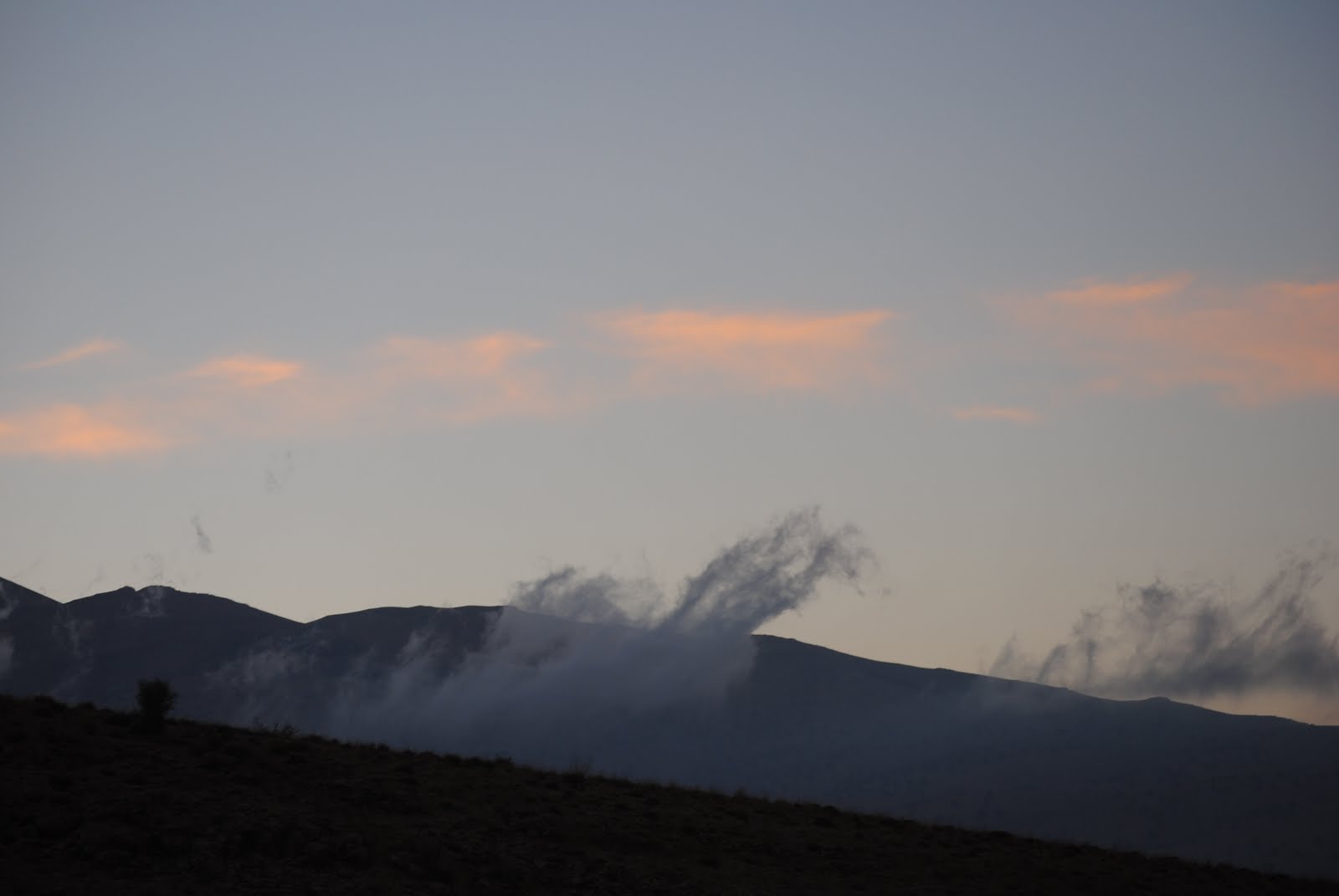

 During the last few weekends I have spent a good deal of time outside of Beirut. This past weekend I was with friends at an eco-lodge near Hermel in the Bekaa. Majestic, harsh, unforgiving mountain ranges. Peace, apart from the distant sounds of machine-gun fire from the Hizb'allah training camps in the hidden distance. A warming, enveloping cold. A few weekends ago, near Hammana, a different mountain range, a different non-sense: pine trees, identical and identikit villages nestling on the slopes. And last weekend (or that's at least how it seems), what is without doubt the most alluring place in Lebanon, Sannine. Isolation. Purity. Tranquility.
 Partly to escape from the destruction of Beirut by property speculators, and the attendant noise (so much noise) that comes with it, partly to experience cold, which is long overdue (autumn shows no signs of arriving at any point soon down here in the city by the sea), and partly just to escape from the person that I become when I'm in the city too much. There are other more important reasons, but these will suffice for now.
Coming back to the city, the domestic, to work, containing and isolating my 'dromofilia' is increasingly a struggle, a dilemma better said. I am finding fewer and fewer reasons to do so, and more and more reasons not to do so. There is only one reason why I am still here, back here. Again. Still. Yet.
"The experience which I am attempting to describe by one tentative approach after another is very precise and is immediately recognizable. But it exists at a level of perception and feeling which is probably preverbal - hence, very much, the difficulty of writing about it...By this time you are within the experience. Yet saying this implies narrative time and the essence of the experience is that it takes place outside such time. The experience does not enter into the narrative of your life..." (John Berger, Field).
Still. Yet. Again. Words which all have double-entendres of a profoundly existential variety, and which describe both a state of being and a non-state of flux. 'Still': not-yet altered, but calm; 'Yet': for-the-moment', but 'however'; 'Again': the promise of continuance, though also the ordered disorder of inertia.
'Live' and 'leave' are two words which, in English, are difficult to phonetically distinguish. I leave because I need to live; in leaving I live. To live is, often, to leave.
Berger talks, in his beautiful, poetic, metaphysical style, about the 'narrative of life.' He is right (or, at least, what he writes resonates so much with me), and sometimes this narrative, however, condenses, crystallises into just a few (dis)connected words. Still. Again. Yet. I am still in Beirut, yet, again, I'm not.
Sunday, 19 September 2010
When Big Brother Gets A Little Too Close...
Last week I discovered that I have a file held by the Lebanese Internal Security Forces. This doesn't surprise me: I'm a foreigner, I work for an organisation funded by the U.S. and operating under the auspices of the U.S. Embassy. The name on my file is mine, with the bracketed appendage "a.k.a. Koutalakis." Now, that 'nickname' is used for many things: three of my e-mail accounts have it or a version of it as the name; one of those accounts is linked to this blog so I have to suppose they are reading this too. it is also my Flickr and Facebook name. It's not that difficult to find this out and link them to me, though I think what surprises me is that anyone would bother. I suppose, charitably, that they didn't know that I wasn't a threat to national security until they had researched and found out that I wasn't. Fair enough.
...and I wonder what else the file contains. Not much, probably, otherwise I would have been either arrested and/or deported by now.
However, the circumstances surrounding my finding out about this file are what interest me. A colleague, in the presence of a third person, happily blurted out that he knew this about me because he has a friend at the ISF who let him, or allowed him, or didn't prevent him from, seeing the files (plural). In one sense this doesn't surprise me either: such is Lebanon. I told my boss about it and asked him to give this colleague of mine the third degree, for obvious reasons. It's partly an issue of confidentiality, but not really that either: when a society is based on transparent superficiality, information becomes a commodity to be traded. So it is everywhere of course, but the information that is most privileged here is trivial information, gossip. From the upper echelons of politics in Lebanon down to the corner cafe discussions, the exchange and possession of the trivial and the superficial become a modus operandi; witness the amount of 'celebrity' magazines, pages in newspapers, and TV shows. So it is almost everywhere, of course, but in a country where even MacDonalds have a valet service and VIP parking, what appears to be so is so, irrespective of any serious criteria.
What makes this different is that this act of reductionism, this particular piece of gossip, was lifted from the secret police. What disturbs me is that I am not at all disturbed by either the existence of the file nor by the fact that whoever is in charge of it shows it to anybody he wishes to. That's Lebanon. Excellent. They can't even get internal security right...
...and I wonder what else the file contains. Not much, probably, otherwise I would have been either arrested and/or deported by now.
However, the circumstances surrounding my finding out about this file are what interest me. A colleague, in the presence of a third person, happily blurted out that he knew this about me because he has a friend at the ISF who let him, or allowed him, or didn't prevent him from, seeing the files (plural). In one sense this doesn't surprise me either: such is Lebanon. I told my boss about it and asked him to give this colleague of mine the third degree, for obvious reasons. It's partly an issue of confidentiality, but not really that either: when a society is based on transparent superficiality, information becomes a commodity to be traded. So it is everywhere of course, but the information that is most privileged here is trivial information, gossip. From the upper echelons of politics in Lebanon down to the corner cafe discussions, the exchange and possession of the trivial and the superficial become a modus operandi; witness the amount of 'celebrity' magazines, pages in newspapers, and TV shows. So it is almost everywhere, of course, but in a country where even MacDonalds have a valet service and VIP parking, what appears to be so is so, irrespective of any serious criteria.
What makes this different is that this act of reductionism, this particular piece of gossip, was lifted from the secret police. What disturbs me is that I am not at all disturbed by either the existence of the file nor by the fact that whoever is in charge of it shows it to anybody he wishes to. That's Lebanon. Excellent. They can't even get internal security right...
Thursday, 19 August 2010
Αληθινη Athenian Democracy
Exiting the Metro slightly ahead of me today were a well-dressed, slightly-older than middle-aged couple. At the top of the escalator they made a strange movement which, when I reached the top, I decided to investigate. In the end it was the most banal, yet most optimistic, thing I had seen in a while: they had left their Metro ticket stuck to the bar at the top of the 'down' escalator, so that anyone entering could take it and use it. Athens Metro tickets have a time limit of one hour and a half so you can have unlimited travel during that period. If, of course, your journey takes ten minutes, then there is still another eighty minutes of use left on it. Moments before, I had seen such a ticket sticking out of the validation machine at the entrance to the station proper, and for the self-same reason. I had learned about this practice some days before, and ever since then I have been offering my partially-used ticket to anyone entering as I was leaving.
On the face of it are a couple of things: it is, of course, illegal. Secondly, the tickets only cost one Euro, well within the means of (almost) anyone. Thirdly, the Athens Metro system (and its associated Proastiakos (suburban) railway), is very good; new stations have been constructed sensitively around the cornucopia of ancient ruins that live underneath the Athens asphalt, many of the trains are new, run on time (...Mussolini would be very proud...), and it is being extended, in all directions, in an intelligent way. All of this takes investment and, of course, one of the ways in which that money is raised is via the sale of tickets to travelers. On the face of it, then, this practice of 'ticket sharing' is harming all of this.
On the face of it...
I've been in Greece for the last two months or so, and I have heard, first-, second- and third-hand a collection of horror stories about life in a country that has been declared "toxic" by the IMF and the EU. I know someone who has been given two choices, either to lose her job now, or to work until Christmas but only being paid every other month; an acquaintance who works so many hours (10 a.m. until 10 p.m is not uncommon for him) that he is seriously considering giving up working for a while; a friend who has been paying the loan on his car assiduously for several years but who, upon missing one payment, is telephoned by the bank continually and without respite and threatened with all sorts of legal and beaurocratic comeback; someone else was told repeatedly that he would be paid 'next month' (and this went on for four months) until, one day, he was told that the company was bankrupt and that he and his colleagues were out of a job and, of course, the promised salaries had disappeared into thin air; another acquaintance and his partner were told that their insurance policies had likewise gone up in smoke because the bank they had been paying them into all of these years went under without a trace, and without warning.
What all of these people have in common is that they belong to "Η Γενιά των 700 ευρώ", the "¢700 generation" (read more about it here http://g700.blogspot.com/) (yes, I know; it's now a "sociological phenomenon" with a label blah blah...forget that for the moment...). With the IMF (the "Troika") flying in this month to give the Greek government a pat on the back for getting down on their knees so quickly, with the "voices of reason" urging 'caution', and 'tightening the belts' and 'pragmatism' so loudly, that generation is slowly, but surely, having its own voice drowned out. For obvious and understandable reasons (riot police and, hey, summer is here after all!) the steam has gone out of the post-'Alexis' anisyxia. So...
So...you do what you can do; give away your unused Metro tickets; the people taking them are the people who most need them. But they are also the people who most appreciate them, who will see that it is not just they who understand what is happening, but that the well-dressed, slightly-older than middle-aged couple still remember what it is like to belong to the "¢700 generation."
On the face of it are a couple of things: it is, of course, illegal. Secondly, the tickets only cost one Euro, well within the means of (almost) anyone. Thirdly, the Athens Metro system (and its associated Proastiakos (suburban) railway), is very good; new stations have been constructed sensitively around the cornucopia of ancient ruins that live underneath the Athens asphalt, many of the trains are new, run on time (...Mussolini would be very proud...), and it is being extended, in all directions, in an intelligent way. All of this takes investment and, of course, one of the ways in which that money is raised is via the sale of tickets to travelers. On the face of it, then, this practice of 'ticket sharing' is harming all of this.
On the face of it...
I've been in Greece for the last two months or so, and I have heard, first-, second- and third-hand a collection of horror stories about life in a country that has been declared "toxic" by the IMF and the EU. I know someone who has been given two choices, either to lose her job now, or to work until Christmas but only being paid every other month; an acquaintance who works so many hours (10 a.m. until 10 p.m is not uncommon for him) that he is seriously considering giving up working for a while; a friend who has been paying the loan on his car assiduously for several years but who, upon missing one payment, is telephoned by the bank continually and without respite and threatened with all sorts of legal and beaurocratic comeback; someone else was told repeatedly that he would be paid 'next month' (and this went on for four months) until, one day, he was told that the company was bankrupt and that he and his colleagues were out of a job and, of course, the promised salaries had disappeared into thin air; another acquaintance and his partner were told that their insurance policies had likewise gone up in smoke because the bank they had been paying them into all of these years went under without a trace, and without warning.
What all of these people have in common is that they belong to "Η Γενιά των 700 ευρώ", the "¢700 generation" (read more about it here http://g700.blogspot.com/) (yes, I know; it's now a "sociological phenomenon" with a label blah blah...forget that for the moment...). With the IMF (the "Troika") flying in this month to give the Greek government a pat on the back for getting down on their knees so quickly, with the "voices of reason" urging 'caution', and 'tightening the belts' and 'pragmatism' so loudly, that generation is slowly, but surely, having its own voice drowned out. For obvious and understandable reasons (riot police and, hey, summer is here after all!) the steam has gone out of the post-'Alexis' anisyxia. So...
So...you do what you can do; give away your unused Metro tickets; the people taking them are the people who most need them. But they are also the people who most appreciate them, who will see that it is not just they who understand what is happening, but that the well-dressed, slightly-older than middle-aged couple still remember what it is like to belong to the "¢700 generation."
Subscribe to:
Posts (Atom)
About Me
- Koutalakis
- Beirut, Lebanon
- Increasingly solipsistic... ...decreasingly materialistic... a wanderer... ...adapt or die...